Possibilities for the Future

With everything that I’ve gone through in college, I’ve always been someone who has looked back and thought of what I could’ve done better or what I would’ve done differently in certain instances. Mainly because I’ve always been remorseful of what I’ve done due to thinking they’d make me look dumb in comparison when really they just make me human. But now I would like to do the opposite of that, I’ve looked at the past too much that I wonder what’s next for me in the future. I’d like to look ahead and see what I can do in the future to be a better person.

My life choices would be something I would improve on, first of all. While it is true that we react on instinct most of the time and even involve human emotion mixed into it, there is a side of me that wants to be more nuanced and neutral with what I see. Not everything would be seen in the same lens mind you, I can only think of a few instances where my decisions would be set in stone, but in every other instance, I would like to step back and look at both sides of the situation. Having myself be more neutral can mean a lot when I don’t try to radicalize my decisions under the same excuse of “because I want to” or “because I feel like it”. This goes with making friends, friends that I can have a meaningful connection with both in the workspace and in my life. It’s easy to see why people would make great connections with others they wouldn’t think to connect with if they were younger, since there’s so much to the human mind that you never get to see since you’re never so preoccupied with how a person acts outside of what they do and where they go. So once you do take the time to step back and see the kind of person they are, it only clues you in onto why they did the decisions they made, whether for personal reasons or any others that make sense to them.

There’s also the matter of seeking help when possible, something I’ve taken for granted for far too long in my career. Growing up, I never thought to seek help for how I’ve been feeling mainly because I’ve grown to not be able to trust people to be honest with their words on how I’m feeling and what I can do to be better. Not to mention the fact that I’m the only one who knows how I feel, at the time, I thought “If I know how I feel, and I’m right about it, well then what can they say about it?” That was my mindset at the time, and it only seems to carry over and bubble overtime as I’ve seen people come and go in my life. During my junior year, I’ve expressed thoughts of demotivation and wanting to stop going to college purely for the fact that I didn’t think it was fun anymore. I would be constantly annoyed with my family, try to push them away, only interacting with my internet friends as a means of escaping the real world while also living in it, only for that escape to come from video games. At the time, I just thought that my anger towards them was just my anger issues bubbling up along with them feeling suffocating to me. Only after some self-reflection that I realize I was only stressed out from school so much that I had no way of releasing that stress outside of video games, and the outlet of that stress would vary in people. I never took the time to seek help even if my mom wanted me to because I just thought I can still brute force my way through, even if it means making myself miserable in the process. That being said, that is definitely something I’d want to take into consideration moving forward since it becomes the sole factor as to whether or not I’m actually happy with where I’m at.

This is where it ends for me, mainly for my college career. And instead of reminiscing about my time here again like I’ve always done, I instead want to extend a helping hand for those who my be starting out or nervous about what to do when they make it to college. So for those reading, take your time with your projects and never stop at making time for yourself. Your time is just as valuable as anyone else’s and it doesn’t stop for you to be indecisive. And even then, you’ve got all the time in the world to explore yourself, see what works and what doesn’t. With your projects, whether it be from homework or just something you personally want to do, always take time to doing them. Even if you have a due date to finish them, always make time to do them as soon as possible, especially if you’ve already made plans for yourself. Always step away whenever you need to, it’s just as important to look after your mental health so you don’t become super fatigued and stressed out over something superficial in comparison. In a world where mental health has gone completely down hill in the past few years, it’s always important to keep yourself in check so as to not be in the same bubble you once were. So my advice to you is take time for yourself and never stop moving. Keep going and you’ll make it eventually.

Design’s effect on Creativity

Graphic Design has a wide variety of design applications that bring it to its full potential. The designer of said applications has been able to do so through their creative mind. The connection between design and creativity lends credence to this idea. But it also has its own set of problems, ones that many designers end up doing without realizing.

One of these is the aspect of imitation. They say imitation is the highest form of flattery, and this plays well in how designers get their inspiration. The inspiration may be from a piece of art, an artist of any kind, a landmark in the world, an event that went on in the world, etc., essentially something that gets one’s creativity rolling. Then it gets to a point where once designing something for themselves, they will find themselves essentially doing the same thing as their inspiration only in their own style. Part of this is warranted especially if the inspiration plays a big role in the designer’s style and appeal. But then it gets to the point where it becomes too 1:1 with the original that it becomes impossible to ignore “A similar design always gets noticed and is always looked down upon, for if your logo is not original, who is to say that, your product is? It is actually putting the integrity of your brand on the line, taking a huge risk when you try to imitate someone else’s already famous logo just so you won’t have to come up with your own, or even if it is because you really like their style, you are not being fair to your client.” even going so far as to make it your identity, something no one in their right mind would want. Imitation, more often than not, has its problems that can get you in a lot of trouble, sometimes in a way that can destroy your connections and all the integrity you may have had.

This leads perfectly into the next aspect, referencing vs copying. Referencing a piece of work or a landmark is always important when it comes to art, any artist/designer worth their salt will tell you that. More often than not, you’ll find yourself referencing something in the real world whether you realize it or not purely on the notion that that something will make your work much better than when you aren’t “Referencing is an important part of academic work. It puts your work in context, demonstrates the breadth and depth of your research, and acknowledges other people’s work. You should reference whenever you use someone else’s idea.” Only problem that arises from this is when people confuse referencing to blatantly copying another person’s work, both from the view of the creator and the view of the audience. Copying a piece of art says more about you as an artist or designer than anything else, showing that you’re both void of any creativity and wishing to be more like your inspiration by any means necessary. The outcome would likely be that your integrity and branding would be seen as just a mere imitation of another person’s, leaving you with a hollow shell of what it was despite having lots of work to show.

All this to say that while design has its positives with creativity, it also has its glaring weaknesses that are too great to ignore. As said before, they say that imitation is the highest form of flattery, but others say that sometimes it’s nothing but a slap in the face. While this saying doesn’t lend credence to the imitations as being made with malicious intent, it does give the idea that imitation doesn’t make things good in the long run.

Social Media and Creative Burn-out

With branding and advertising comes a wide audience, an audience that grows eager to see what your brand can do. But that also has the side-effect of stifling your creativity in favor of pleasing the audience you worked so hard to gain. Especially if the platform you’re on is a platform that warrants that kind of behavior. This can get really tiring if all you’re looking to do is spread your creative juices for everyone to see and nothing more.

Part of this experience comes in the form of Constructive Criticism. In its literal definition, Constructive Criticism is a form of criticism that “focuses on providing constructive feedback, supported by specific examples, to help you improve in some area.“, in other words, a form of feedback that allows you to see the flaws of your work and where you can improve from the lens of another person in a friendly manner. Inherently, there’s nothing particularly wrong with this as it provides a sense of connection between the creator and the audience. The problem arises when some use this form of criticism as a means to hide the fact that they’re simply being negative about your piece or cracking jokes about what it is. A form of fun that does nothing but undermine your hard work in favor of getting in a few cheap lols here and there. As far as the creator is concerned, the comments provided by the audience in terms of criticism and feedback can be both a blessing and a curse, while it provides a sense of connection as stated earlier, it can also be detrimental to their growth. The ones who take the feedback may also potentially be the ones who will rely on it to get better, and while there’s nothing wrong with that, it can be demoralizing when someone looks at your work, just simply says “It’s bad” and call it a day. Not only does it not help in making you see what’s wrong, but it also makes you not want to do another one out of fear that it would end up the same way.

This fits perfectly with the desire for attention and creative burn-out, two separate traps that many creators have fallen victim to many times on different platforms. Let’s use YouTube as an example instead of Twitter this time since it’s the only other platform where creativity is put on full display, especially when it’s in video format. Once you put out enough content for people to sink their teeth into and give their feedback, you start to get this sense that you’re needed in a way, that you’re required to put out more content solely for the need of the audience. At that point the easiest thing to do to remedy this is to look towards the feedback and just assume that what your doing is good and to keep providing it in hopes that those people continue coming back. This sets off the desire for attention, especially with the idea that YouTube has a strange algorithm that favors videos with higher engagement and user feedback. One look at your content compared to the ones on the site’s recommended page or, more similarly, Twitter’s trending page and thus begins the cycle to being good enough to be on there, which all involves attention from your audience. All of this leads into creative burn-out, a mindset that continues to grow throughout your branding experience. To its definition, “Creative burnout is the feeling that you’ve drained all of your creativity, and there is nothing left.“, and this only exacerbated by the idea of having an audience that is constantly eager to see you creative expression. When you have that mass appeal, your creativity will often either plateau or just completely plummet since you’re doing it for the crowd as opposed to yourself. That then leaves you feeling like you’re wasting your potential but still need to keep pumping them out otherwise your audience will lose interest and you lose that recognition you had before. Which then inclines you to stop, whether to focus on work for yourself or on your own mental health or anything else that may be hindering you.

All this to say that social media’s influence on design and animation has its negative areas, both of which connect with each other. Not only with the desire to keep going and keep the audience you have but also the deep-seated reliance on criticism and feedback.

Social Media’s Influence on Design and Animation

Graphic design has a lot to offer in terms of its namesake and what it can do to enhance the experience for a wide range of audience. This is especially true when it’s done in a medium such as animation, where moving pictures and drawing poses a thousand times is the key component to making it look good. What many people don’t ever bring up, however, is how social media plays as a major inspiration to many of these factors. Playing off of the quote “Art imitates life”, the events on social media and even the different forms of art that is shared on social media, helps in giving more interesting ideas and even resources to make animations look good and making the experience much better in the long run.

This is associated with branding as it all involves making your brand known to the public. What most people will notice right away while doing so is that there are plenty of other people doing the same thing, whether it’s with their own brand or just simply putting themselves out there for others to see. And with other people’s work comes both new clients to make connections with and artwork to draw inspiration from. In the case of Graphic Design, you get to see how others try make their own artwork and be unique with them, partially because of their creative intake but also because of something that inspired them to make these in the first place. Same goes for animation as far back as the first animation ever done. Many of the most popular and famous animations, such as ones made by Disney, were inspired by real-world events and cultures that have a certain amount of significance. From the old European castles, to the Arabian Nights stories, to underwater exploration, to family lineage, there was always something that inspires someone to make something into a work of art, and animations involve moving drawings of aspects of the real world. This idea is then accentuated with social media where world events and discourse are at an all time high. Both graphic design and animation have a place in social media because of this new wave of information.

With social media also comes exposure and reaction from a wide audience, which also comes with advertising and showing work. Many people will have the opportunity to see what you/your brand is all about and what they can expect. They give their reactions to it however way they know how and even give feedback on what they think, giving the opportunity to improve in your craft from people who like your work, both people from inside or outside the graphic design/animation industry. This one quote from the article, “The Relationship Between Graphic Design and Social Media”, explains this connection through first impressions, “Social media is a real time, instant access place, which means that first impressions are incredibly important. Profiles, cover images, avatars, and icons are often the only thing people see about you before they keep scrolling. Graphic design sets your profile and brand apart in a sea of competition, especially on huge platforms like Facebook, Twitter, and Instagram.” All this to say that feedback comes easy with exposure and experience. You see where people think your work can improve on, and use that as a motivator to make the next thing you do a lot better, whether improving in visibility or user experience.

In the end, the impact social media has on graphic design and animation is staggering to say the least. Many designers and animators have a good place for resources, exposure, and feedback while the audience gets a great product in return. In being advertised, your work gets more advertisement in the long run, and social media is arbiter of that.

Brand Building

Even in the days of old on the internet, building a brand is something fundamentally important to getting yourself noticed. Having a brand for yourself can spell the difference between working with clients and being noticed in the workforce. And even if you’re not looking for a place to work, it’s still important to have a dedicated brand for people to at least recognize you on other social media platforms and even other areas in real life so to not confuse you with someone else in case they want to see what work you’ve done. The only thing to gets in the way of that is identifying your audience and identifying what career path your on and how you want to articulate it in the best way possible.

The first thing that needs to be done is making a logo. A logo is the main factor that separates you from someone else, since it’s the primary identity you’ll have outside of a real life picture of you. It also reflects who you are as a person and how you want yourself to come across to other people. Something simple can signify that you’re more laid back and have a simple way of going about designing products while something more complex can reflect on the attention to detail you have and how meticulous you are for making a product look good. One thing that helps is identifying the audience you want to appeal to and who your work is tailored to as that could be the defining factor that makes your work stand out from your logo. This is all brought up through research, experimentation, and even observation as to who gravitates to your work the most.

While researching your audience can be monotonous and time-consuming, it’s extremely important as to not show your work to the wrong people. One strategy that helps with it is through social media, putting your work out there and observing the reactions and engagement it gets and who that is coming from definitely helps in understanding where your brand lies and what your content should be moving forward. This is especially true when it comes to stylizing your website around your brand, something that only helps much more in making an identity for yourself. Part of this involves your use of social media and how you decide to promote your work on social media. One article, “Brand Building Meaning, Importance & Process” describes this aspect in the best way possible, “Advertising & promoting the brand using TVCs, social media, print ads, online advertising etc. is one of the most important pillars of brand building as it helps in creating brand awareness. Correct communication and effective media channels can help build a strong brand and helps increase brand recall.”

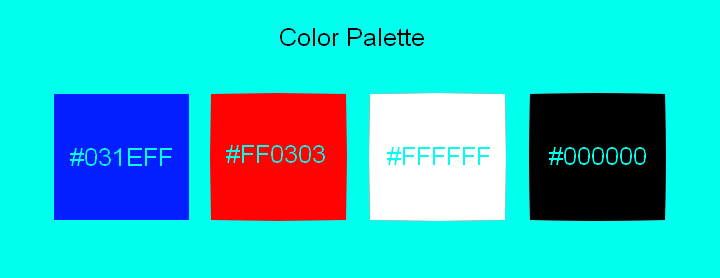
One aspect that helps in designing your brand is deciding on a color palette, whether it’s something vibrant and appealing or gloomy and avant-garde, colors are the defining trait of just about anything in media. This color palette can either be a combination of some of your favorite colors that you’ve gravitated towards or a mix of colors from your most recent/popular work as that’s what people will associate your brand with. Even with the randomness of the colors, it still helps in identifying who you are and what type of creator you are as it can tell your audience that you have more freedom with whatever you create.

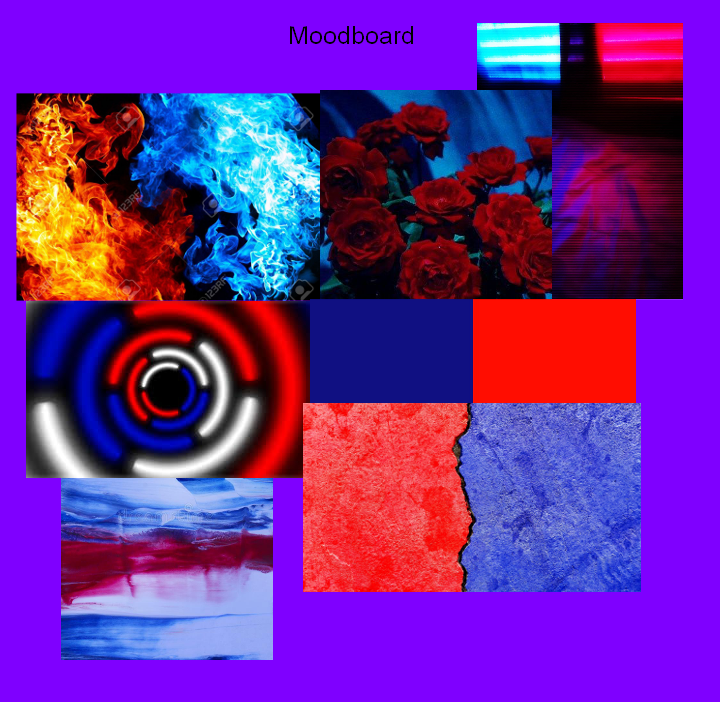
A helper with the color palette is a mood board, a composition that gives your audience a better idea of what to expect from you and how you will appear on social media. Mood boards can vary in range when it comes to colors, though it’s usually held together by images that have similar aesthetics that indicate similar appearances to what you want. Something more avant-garde, for example, would have more darker colors and a darker atmosphere, usually indicating to the audience that it’s either more mature in aesthetic or it’s something involving vulnerability and personal experience, a big inspiration in design. One article, “Brand Identity: The Importance Of Color“, puts it in a couple of words that describes it in the best way possible, “Usually, it is advantageous for a brand to consistently “own” certain colors, which provide an additional recognition cue.”

Overall, color and design are the most important aspects when it comes to building a brand outside of a social media following. Not having a brand can hinder you when it comes to growing an audience and putting yourself out there for the workforce or even for other pastors in life.

Ransom Notes

Ransom Notes is a weird concept that a lot of people have dabbled in. It is essentially taking a bunch of letters from a magazine, newspaper, comic book, or anything that has large letters on it and put them all together on a sheet of paper in a way that makes them spell out a message. It can be any message that a person desires to put up, but most ransom notes end up spelling out demanding messages. Some examples include “Leave a bag of Fritos at the door at 8:30. P.S. Bring dip”, “Give us the stamps and nobody gets hurt”, or my own ransom notes that spell out “Bring your brain cells, they are necessary.”

What ransom notes have that differ from regular typography are the different fonts and typefaces that are juxtaposed together in a number of ways. In regular typography, the typefaces are usually the same depending on whether you’re writing or typing a sentence, although it usually amounts to the same thing throughout. When doing a ransom note, however, the typefaces are all random and usually has only two or three letters that are relatively the same, leaving you with a lot of room for interpretation than usual as to how to convey your message.

That is exactly what I had to do for my final project, as I had to come up with something clever, funny, and demanding to be a ransom note. I came up with a couple of ideas but I ended up with what I noted before as “Bring your brain cells, they are necessary.” I chose that because it can come off as a demand/threat to the majority of people who do a lot of nonsense in this world just for attention. To them, it comes off as “Hey, use your brain and don’t do anything stupid that’ll get you in trouble.” Though the number of people I said the quote to in my class, they thought it was a bit funny, which is also the point of the note, to be funny and demanding at the same time.

Altered Images

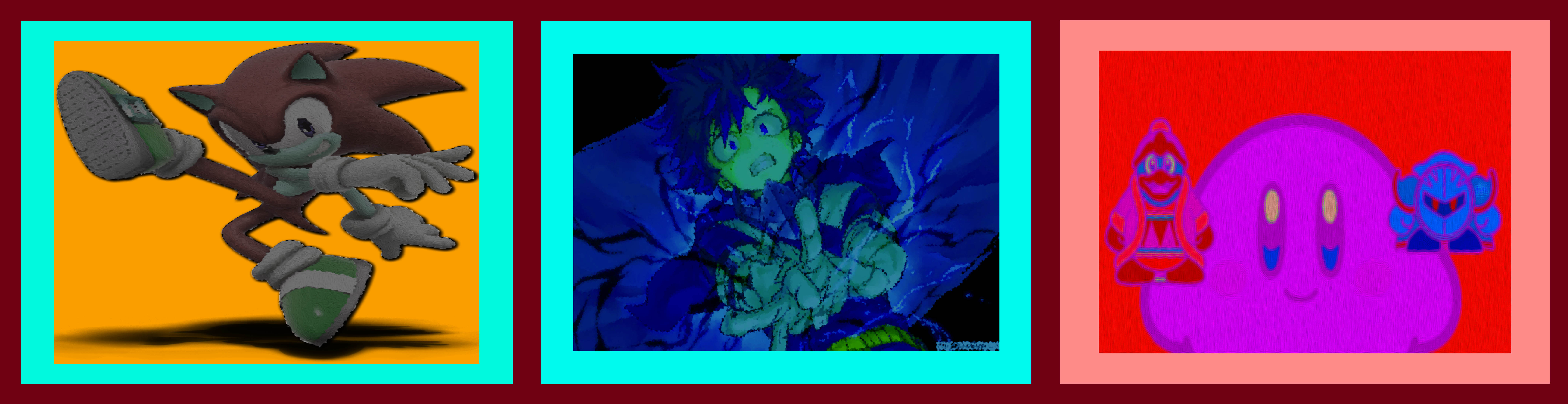
For this assignment, I had to make a few weird changes to some images I found that I’m able to alter at will. For one, I had to see which filters would work best with these images and how they could make them almost unrecognizable that they can be distinguished between different alters. Especially with images that had backgrounds to them that add a bit of flare to them. Secondly, I tried giving them different backgrounds so when they come together, they would each stand out a bit on their own. The color resolutions are altered from the hue and saturation as well as the color balancing of each image. The dimensions were set to match the middle image while the background is made a bit bigger just to fit the images into the frame. Some design principles I considered are ones that deal with images standing out and what colors would work better on an altered image, all of which may be useful down the line when making original art.

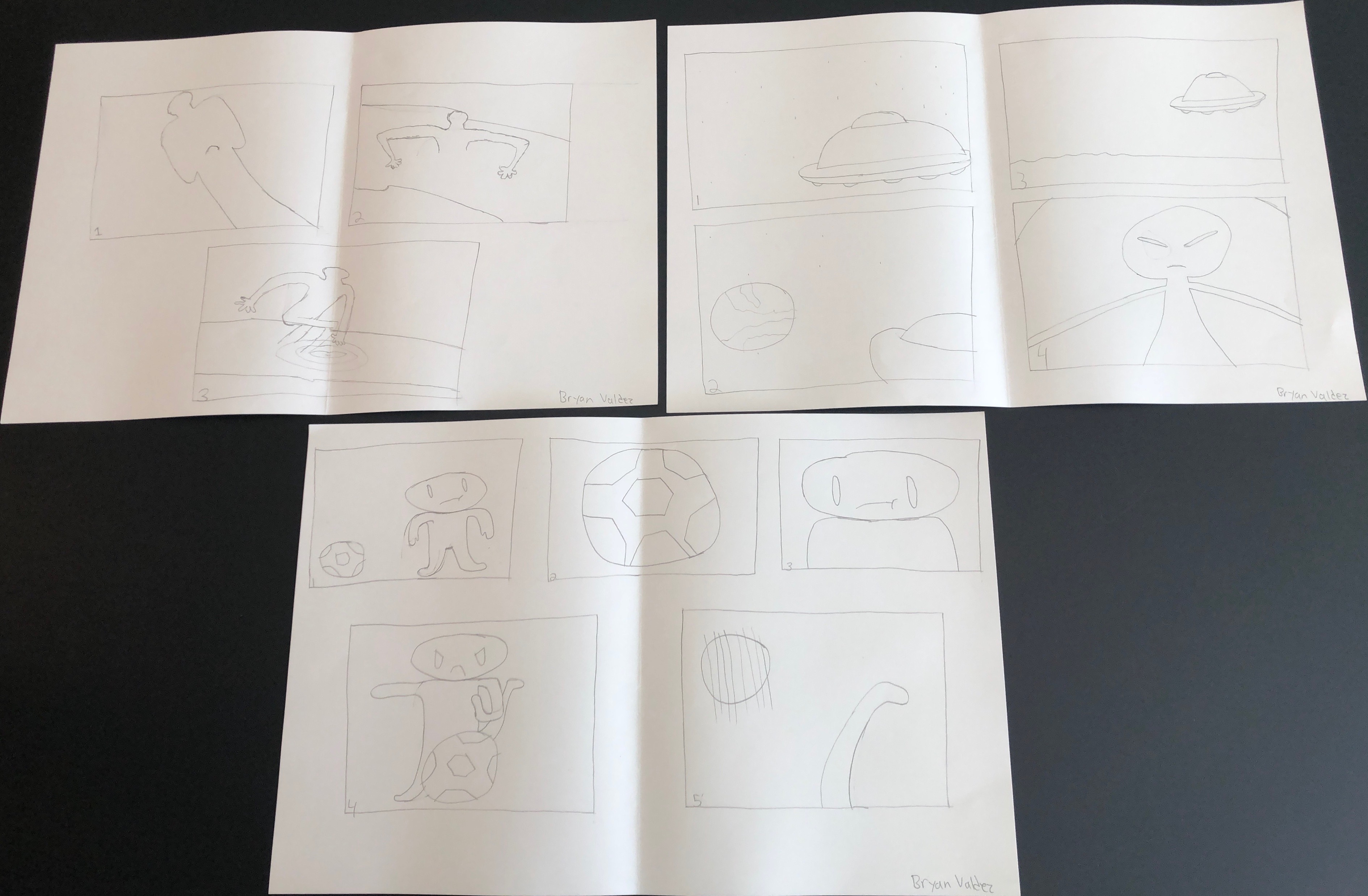
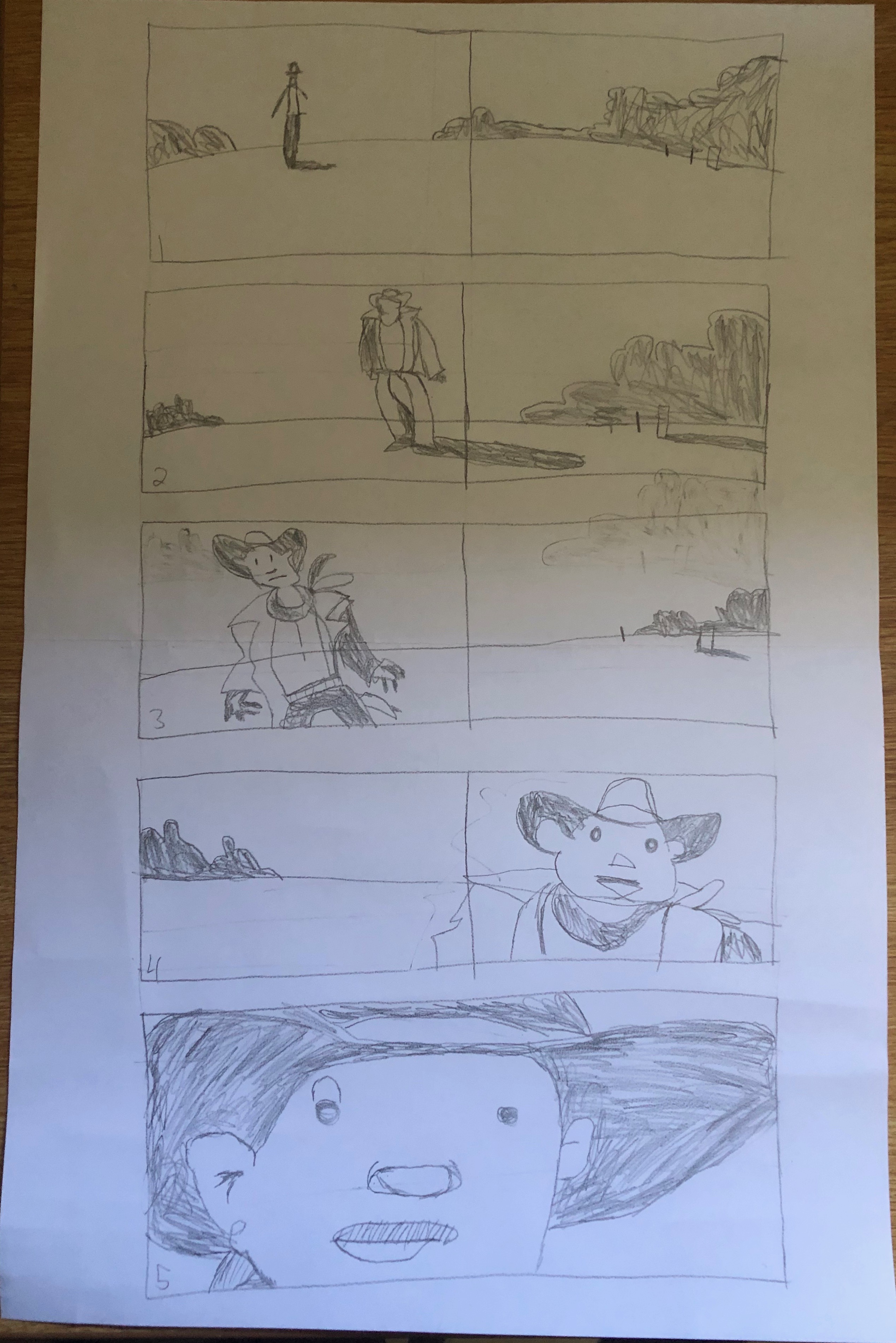
Original Storyboards

When thinking about it, making storyboards seemed like a cake walk for me. Just think of several different ideas I could put into three, four, and five frames and I’m set. Little did I know, this would turn into an interesting process that actually took me so much time to do. When coming up with an idea for a simple storyboard, I wanted to show something that seemed out of the ordinary and surprise the audience in a way they wouldn’t know. Just coming up with ideas is simple thanks to my creative thinking cap, but putting those ideas on paper was admittedly hard to do.

For my three frame storyboard, a shadow is cast over and a black humanoid figure rises from it. It’s a simple story and can be told with more frames but that’s about as simple as I can make it.

For my four frame storyboard, an alien flies off to another planet to gather information in order to conduct research for his home planet. While it is something done before, not many people would think to see what the aliens do when they find a planet they’ve never heard of before.

And for my five frame storyboard, it’s just a simple “guy trying to kick a soccer ball” kind of story. Reasons as to why I made that one is because I got lazy and I wanted to do something quick since it took me until before class to even make the storyboard.

So barring the “storyboard block” I seem to have with this, it was very interesting to just come up with ideas from scratch and draw them on paper.

Story-boarding 101

If you’ve ever seen someone make drawings in a specific order that makes sense, they’re most likely doing story-boarding. Story-boarding is a type of prototype in which you draw up a bunch of sketches based on a story you want to tell on a comic book or animation.

Each one of the sketches represents specific transitions of frames that the creator wants the story to look, making the illusion of smooth animation. Storyboarding is used in many works of art, whether it be a graphic novel, a comic book, a manga, or even many forms of animation like cartoons and anime.

This practice of prototyping serves as the skeleton for the story being told before the whole thing is shown off, just as a way of getting you through the process so you can knock it out in one go. In many cases, storyboarding makes the process of making an illustration or animation of the story somewhat easier since you’re laying out the blueprints for what it needs and what it should look like.

According to “What Is A Storyboard And Why Do You Need One?”, some helpful tips to keep in mind when making a storyboard include:

  • Show, don’t tell: Using illustrations as opposed to dialogue.
  • Being cinematic: Doing something unique that no one else does.
  • Making sure that it’s logical and coherent: Having it make sense and be consistent throughout.
  • Picking a theme: Knowing where the story goes and what’s relevant to it.

All these tips in mind help to make a skeleton of a project that the audience can understand and be satisfied with its consistency. Whether it’s through animation, illustration, or filmmaking, storyboarding is essential for completing projects in a miniscule amount of time.